To create his paintings, John James Audubon (1785-1851) shot birds and
contorted their bodies into dramatic poses by wiring and pinning them
onto boards. The quirky postures were not immediately popular with the
scientific community. Instead, the Academy of Sciences in Philadelphia
published the work of other artists who recorded birds in less
flamboyant poses. Audubon’s work first gained notoriety in England,
where “the American Woodsman” fascinated his patrons. His fame earned
him a place in the Royal Society of the Sciences. Today, he is the
namesake of the Audubon Society, and now many bird-watchers share a
similar goal to Audubon: to record every species in the country on
their personal ‘life lists’.
It was Roger Tory Peterson (1908-1996) who pioneered the idea of a
field guide. His guides highlight observable marks, pointed out by
carefully placed arrows, which allow for the identification of birds at
a distance. Peterson painted thousands of systematic illustrations of
birds in static poses which he based on photographs, bird skins, and
field observations. Field guides have allowed hobbyists, artists, and
scientists to identify birds with binoculars instead of a shotgun.
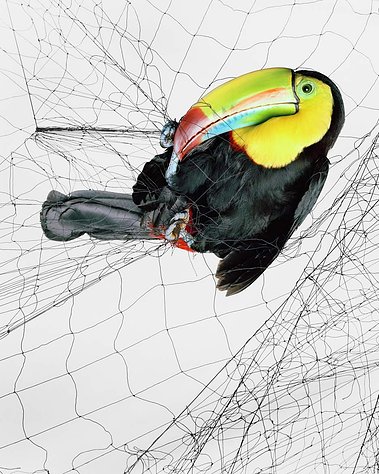
Ornithologists now use mist nets instead of shotguns for data that
cannot be obtained with the help of binoculars, microphones, or
telephoto lenses. These nearly invisible nets are set up like fences
and function as huge spider webs, catching unsuspecting birds. The
researcher carefully extracts the bird from the net. Each bird is
measured, aged, sexed, and banded with an individually numbered anklet
(Audubon’s philopatry experiments with Eastern Phoebes was likely the
first bird banding done in the United States). Then the bird is
released, back into the wild.
John James Audubon’s Monograph, Birds of America, and Roger Tory
Peterson’s Field Guide to the Birds of Eastern and Central North
America were the first pieces of artwork I loved. I spent days studying
and trying to emulate Peterson and Audubon as a bird-watching teenager.
With these artists still on my mind, I set about on this project. I
have chosen to photograph birds while they are caught in mist nets.
Here, the birds inhabit a fascinating space between our framework of
the bush and the hand. During this moment the captured creature can be embarrassed or fearful or angry. It is a fragile moment before
they disappear back into the woods, and into data...